You can build a website with AI in minutes now. Describe what you want, watch it come together, make a few changes, and suddenly you have something that looks like it took weeks to create. It's pretty incredible, and I'm ridiculously excited about the possibilities.
But there's something I think we're overlooking in all this excitement: building a website and running a website are two completely different jobs.
I've seen this firsthand: a client can be thrilled with an AI-generated website. It looks great and does what they need today. But the questions that matter six months or two years down the line aren't necessarily the questions they're asking when they first launch.
What happens when the business grows? When they need to regularly publish content, improve their search visibility, update their services, or have someone else manage the website? What happens when a form needs to do more than display a success message?
These are the kinds of things I want business owners to consider before choosing how to build their websites. Because while AI has made the creation process dramatically easier, it hasn't eliminated the need for a thoughtful digital foundation.
And sometimes, you don't need that foundation at all.
Sometimes a small job deserves a small website
One of my favorite uses for AI is prototyping. If I have an idea I want to experiment with, I love being able to get something on screen quickly without committing to an entire development process. There's something really liberating about seeing an idea come to life while you're still figuring out whether it's worth pursuing.
An AI-built website is especially useful when you're creating something focused, like:
A landing page to test a new offer or collect interest.
An interactive calculator, quiz, or recommendation tool.
An event guide, itinerary, or temporary campaign.
A prototype you want to share before investing in a larger project.
A standalone experience with one clear purpose.
For example, imagine you've got a new service idea. Rather than building an entire website around it, you create one simple page, connect a signup form, and see whether anyone's interested. That's a fantastic way to use AI.
The important distinction is that the page might be simple, but the functionality behind it still needs to work. If you're collecting information, it needs somewhere to go. If you're offering a quiz, you need to decide whether it's simply displaying a recommendation or actually capturing customer responses.
A beautiful interface doesn't automatically mean there's a functioning system behind it.
A website is more than a pretty facade
Here's where my perspective as a website strategist comes in.
People often come to me because they want a website that makes their business look credible. They want somewhere to showcase their work, explain their services, and establish that they're legitimate.
I get it. Credibility matters. But I think we can ask a whole lot more of a website than that.
Instead of simply listing completed projects, I see an opportunity to create strategic case studies that demonstrate how you think, solve problems, and deliver results. Rather than repeatedly answering the same questions over email, I see an FAQ page that becomes a useful resource for customers and saves the business owner time. And instead of a static collection of credentials, I see a searchable library of expertise that can continue helping people long after it's published.
A well-designed business website should be doing several jobs at once:
Establishing credibility: Showing people who you are, what you believe, and why your expertise matters.
Guiding decisions: Helping visitors understand what they need and what to do next.
Reducing repetitive work: Answering common questions and providing useful resources.
Making expertise discoverable: Organizing knowledge into content people can search, scan, and share.
Supporting business operations: Making it easier to inquire, book, buy, or work with you.
That's the difference between having a website that shows you're credible and having a website that puts your credibility to work.
Your website is also one of the few places online where you have meaningful control over your narrative. You're deciding what people discover, how your expertise is presented, and how visitors move through your world. You control your domain and content strategy, even when you're using a managed platform to host the experience.
To me, that's an incredibly valuable business asset, and one worth building intentionally.
Building is one job. Operating is another.
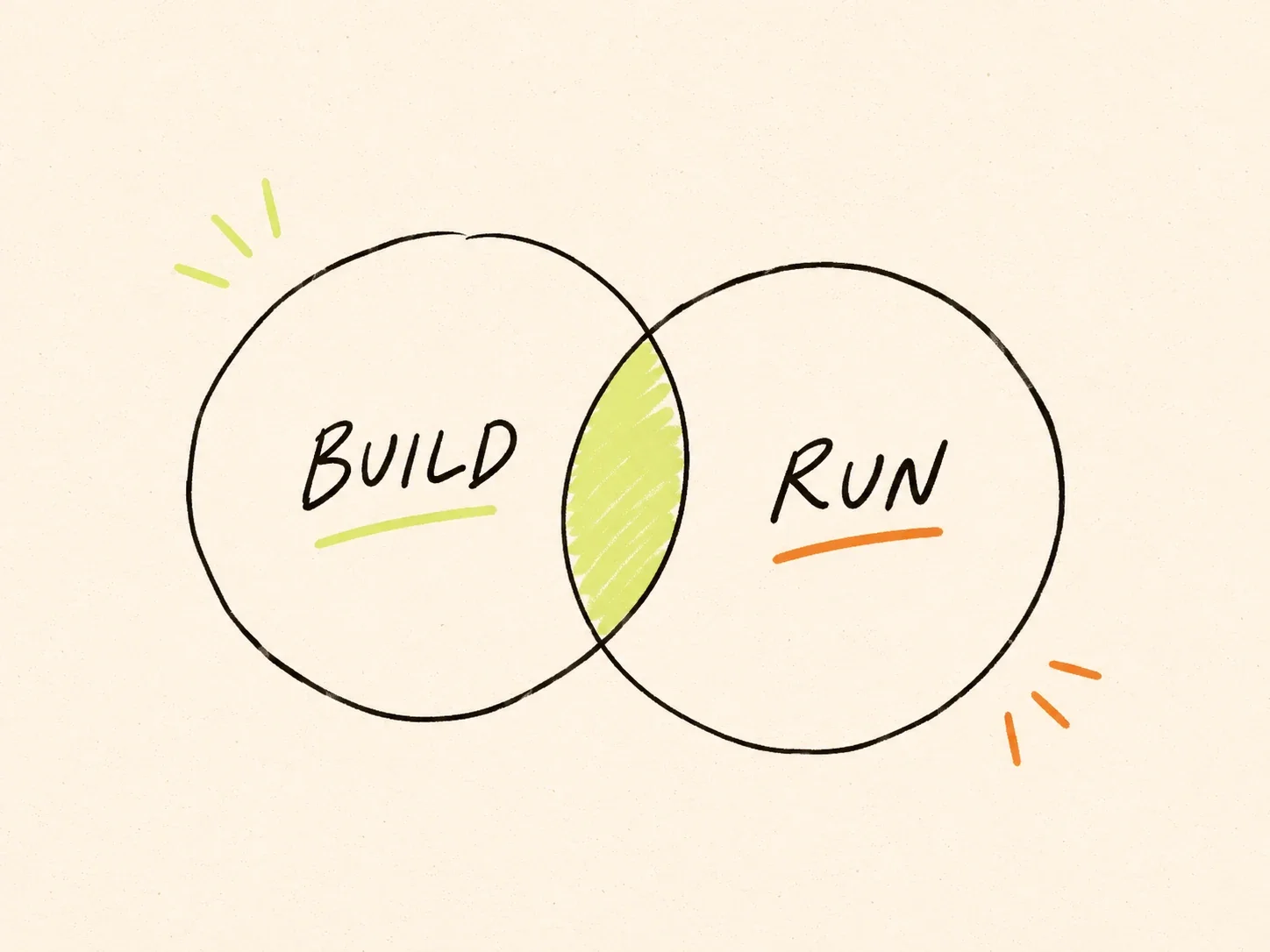
When you build a site with AI, the creation process can feel almost effortless. AI can generate the design, copy, code, and even sophisticated interactions. What it doesn't necessarily provide is everything required to operate that website over time.
That's where I think people need to look a little deeper.
A business website typically involves several moving parts: hosting, domain management, security, content publishing, search optimization, forms, integrations, and regular maintenance. Some AI website builders include many of these capabilities, while others primarily help you generate and deploy code. The experience varies enormously depending on the tool and how you've configured it.
Platforms like Squarespace bundle many of those responsibilities into one environment. You're not simply paying for a website editor. You're paying for infrastructure that makes the ongoing work of running a website more manageable.
Consider content management, for example. If you're adding blog posts, updating your portfolio, creating case studies, or publishing events regularly, you need an organized way to manage that information. That's what a content management system, or CMS, is designed to help you do.
SEO is another consideration. An AI-built website isn't automatically bad for SEO, and Squarespace doesn't automatically guarantee good rankings. But either approach needs thoughtful site architecture, crawlable content, useful information, and the ability to keep improving what you've published. For a growing content library, having an established publishing system can make that work considerably easier.
And then there are forms. I've seen how easy it is to create a convincing-looking form with AI, only to discover that no information is being stored or delivered anywhere. The interface exists, but the actual process doesn't. You can absolutely connect a database or form service to an AI-generated website, but that's another piece you need to configure and maintain.
All of this is possible with custom development. The real question is whether you want to be responsible for assembling and maintaining the pieces yourself.
AI websites vs. Squarespace
Here's how I'd think about the decision if you're building something for your business.
| Consideration | AI-built website | Squarespace |
|---|---|---|
| Best suited for | Focused experiences, prototypes, custom tools, or bespoke websites | Ongoing business websites with structured content and operations |
| Getting started | Can be extremely fast, depending on the tool | Guided visual website-building process |
| Design flexibility | Potentially extensive, including custom code and interactions | Flexible within the platform's design and development options |
| Content management | Depends on the tools and CMS you connect or build | Built-in content publishing and management |
| SEO | Fully possible, but implementation and maintenance vary | Built-in SEO controls and publishing structure |
| Forms and data | May require a connected form service or backend | Built-in forms and integrations, depending on requirements |
| Maintenance | Depends on hosting, architecture, and services used | Much of the platform infrastructure is managed for you |
| Team updates | May require a CMS, editor, or developer workflow | Contributor access and visual editing |
| Cost | Varies widely, including hosting, integrations, and maintenance | Subscription plus any additional services or custom work |
Neither approach wins every category, and that's the point. An AI-built site can absolutely become a sophisticated, long-term business website. It just needs the right architecture and someone responsible for the ongoing work. Squarespace makes many common business requirements easier by providing those systems in one place, although it has its own limitations when you need highly specialized functionality.
The goal isn't to choose whichever option seems more impressive. It's to choose the setup you can actually with comfortably.
The temporary wall vs the foundation
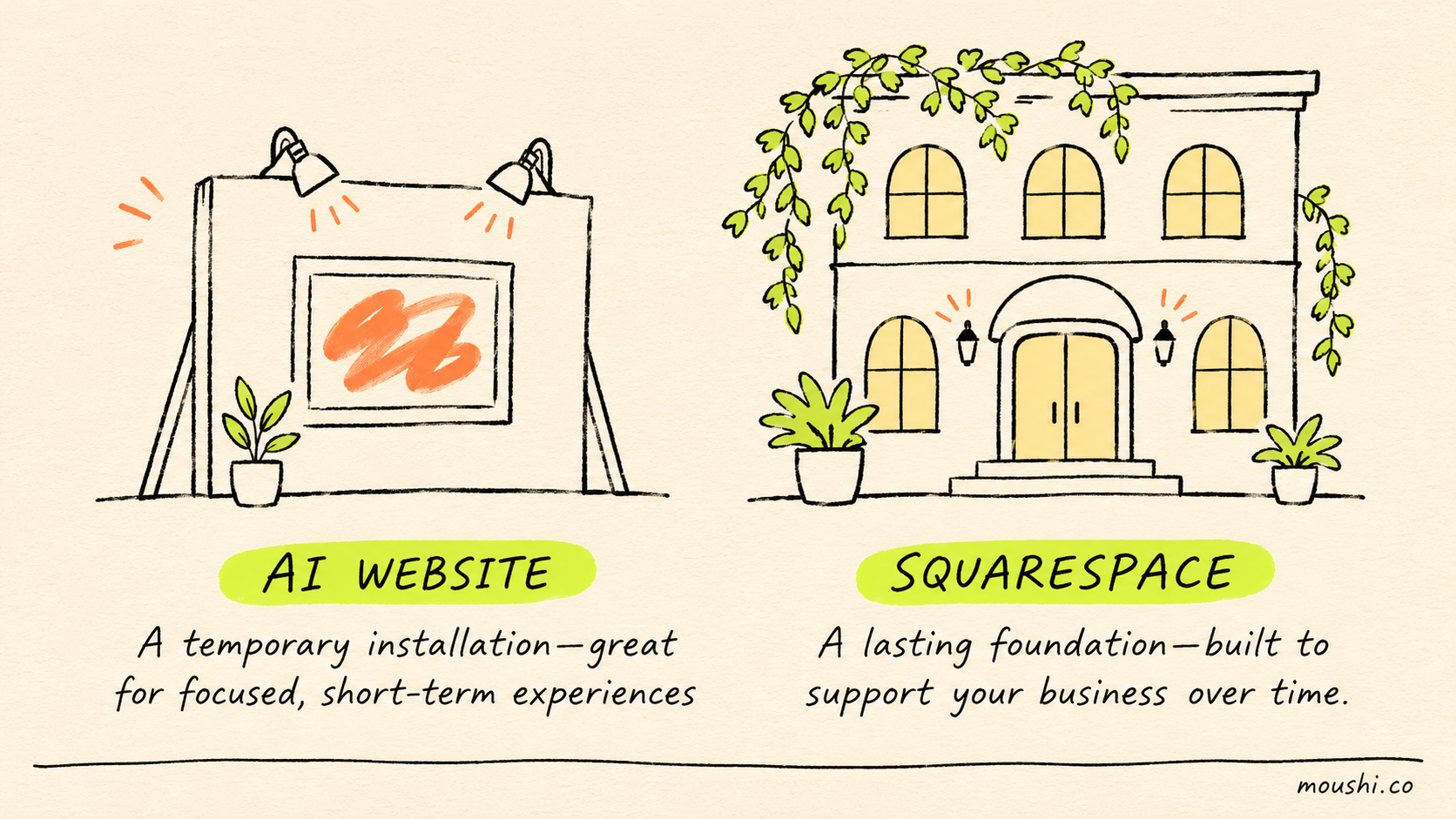
I keep coming back to an architectural analogy.
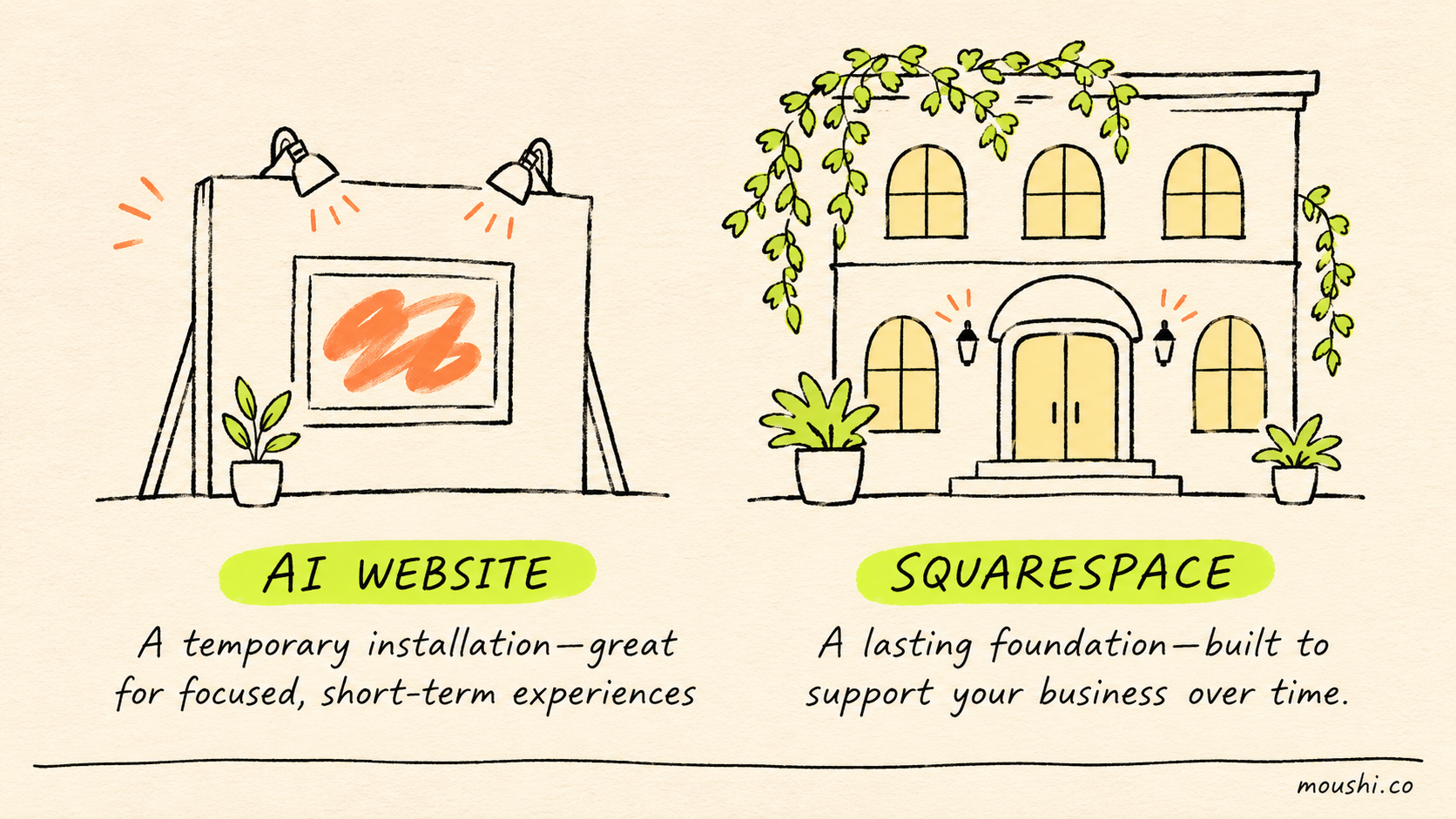
Think about the temporary walls you see in an art gallery. They're beautiful, functional, and designed to support a particular exhibition. They can transform a space quickly, and when the exhibition ends, they can be moved, replaced, or taken down.
That's how I think about many of the small websites and experiences we can create with AI. They're excellent at doing a specific job without requiring us to build an entire digital ecosystem around them.
But when you're opening an actual gallery, you need more than temporary walls. You need a building, with electricity, storage, security, and the infrastructure to support everything happening inside.
That's what a managed website platform can provide for a business.
Of course, you can use AI to build the entire gallery, too. But somebody still has to make sure the lights work, the doors lock, and the building can support what happens next.
The metaphor isn't about one being better than the other. It's about understanding what you're actually building.
My favorite approach is to use both
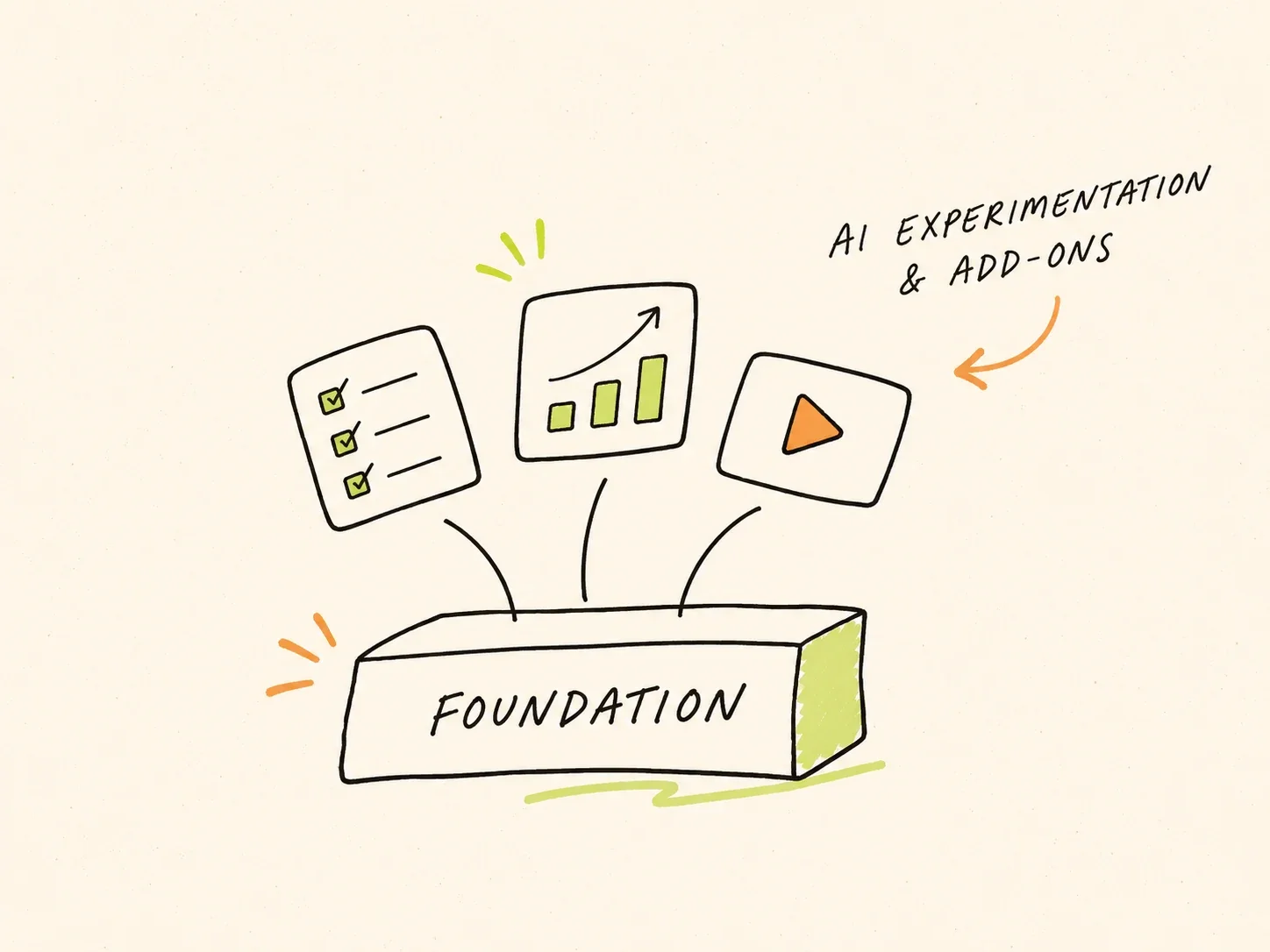
I don't think we need to choose sides here. In fact, one of the most interesting opportunities I see is combining a stable business website with the flexibility of AI-built experiences.
I have a digital tool hosted on my Squarespace website, and I love thinking about websites this way: a central home for your business, content, and customer relationships, then add useful, interactive experiences that make that home more valuable.
Maybe that's a calculator that helps potential clients estimate their needs. Maybe it's an interactive checklist, a personalized guide, or a quiz that makes a complicated decision easier.
Instead of using AI to replace your entire website, you're using it to make your website more useful.
And to me, that's where things get interesting. We're no longer limited to choosing between a traditional website and a custom interactive experience. We can build a thoughtful foundation and then experiment on top of it.
The website you want to run
We live in an extraordinary time for making things. The distance between having an idea and seeing it come to life has become incredibly small, and I think that's worth celebrating.
But if you're building a website for your business, I'd encourage you to think beyond launch day. Think about what you'll need to update, how people will discover your expertise, what happens when customers take action, and who will be responsible for making everything work.
If you're creating one focused experience, an AI-built site might be exactly right. If you're building a long-term digital home for your business, a managed platform may be worth every penny. And if you want the best of both worlds, there's no reason you can't combine them.
A website shouldn't just make your business look credible. It should put that credibility to work.
That's the kind of business website worth building.